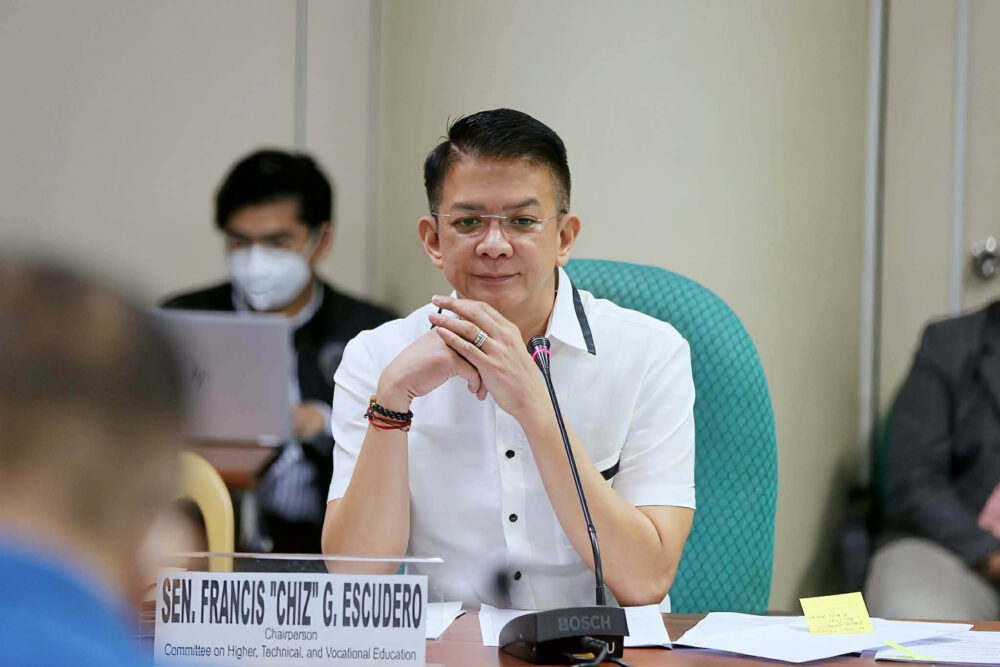
Sen. Francis “Chiz” Escudero over the weekend urged private companies to consider adopting a Malacañang-backed four-day onsite workweek or implementing staggered work-hour schemes as the country prepares to cushion the impact of fuel price increases and wider economic disruptions amid escalating tensions in the Middle East.
In a statement, Escudero said flexible work arrangements could help reduce daily transportation demand, lower operating costs, and give workers added relief while global oil markets remain volatile. He added that such measures could also help minimize billions of pesos in economic losses caused by daily traffic congestion.
“Acting this early as we anticipate what could possibly happen would strengthen the country’s resilience should the situation worsen,” the senator said.
The veteran lawmaker noted that Congress has long practiced a four-day workweek for its personnel and suggested that expanding similar arrangements more broadly could help cut fuel consumption, conserve energy, and ease traffic on major roads.
He added that participation from the private sector would significantly amplify the benefits of the government’s temporary shift to a compressed work arrangement, particularly in key business hubs.
The Bicolano senator specifically encouraged companies in Makati and Bonifacio Global City to explore flexible work setups that could substantially reduce peak-hour congestion.
“These areas experience some of the heaviest daily traffic volumes, making them ideal starting points for mobility-oriented workplace reforms,” he said.
Ferdinand “Bongbong” Marcos Jr. earlier ordered a temporary four-day workweek for selected executive branch offices beginning March 9 as part of efforts to conserve energy and reduce fuel consumption.
The directive, contained in Memorandum Circular No. 114, requires government agencies to cut electricity and fuel use by 10 to 20 percent, maintain air-conditioning at 24°C, and suspend non-essential travel and activities.
The circular also allows agencies to adopt the four-day onsite arrangement either through a compressed workweek or by designating one work-from-home day, in line with policies of the Civil Service Commission.
Meanwhile, a study by the Japan International Cooperation Agency estimates that traffic congestion in Metro Manila costs the economy about P3.5 billion daily, a figure projected to increase to P5.4 billion per day by 2035 if left unresolved.
“If we are losing P3.5 billion every single day because of traffic, that means Metro Manila is bleeding roughly P105 billion a month and more than P1.27 trillion a year,” Escudero said, adding that even modest reductions in congestion can translate into massive national savings.
The senator also called on local government units in major business districts to work with employers in developing area-wide mobility strategies, including synchronized staggered work schedules, improved pedestrian infrastructure, and safer cycling routes.
He likewise urged the public to help conserve energy through simple daily practices such as biking short distances, carpooling, and adopting energy-efficient habits at home.

- I Am Loved: Calamba Youth reminded that Mental Health support begins with being heard - September 20, 2026
- Perpetual at 50: Character Building is Nation Building - September 18, 2026
- Modernization of border security now an imperative — DOJ chief - September 16, 2026